
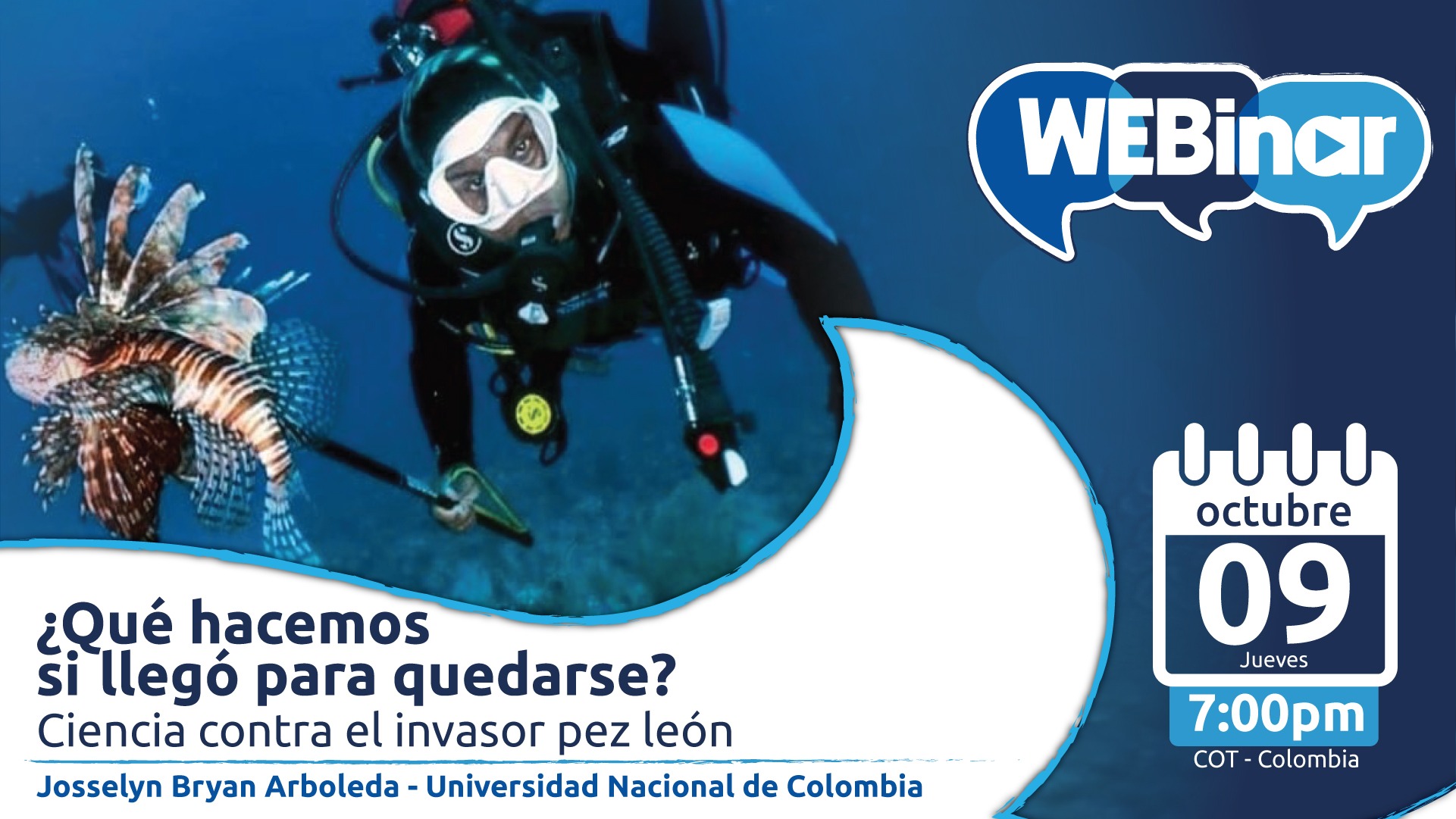
09 Oct What if it’s here to stay? Science Against the Invasive Lionfish
The lionfish (Pterois volitans) is an invasive species that has become established throughout the Caribbean. It was first reported in Colombia on the island of Providencia in 2008. This species preys on organisms of ecological and economic importance, negatively affecting the ecological integrity of the island’s ecosystems.
This research examines the ecological and behavioral traits of the lionfish (Pterois volitans), an invasive species established on the coral reefs of Providencia Island, which is now also found along Colombia’s continental Caribbean coast.
This webinar explores the species’ behavior, recruitment patterns, sexual dimorphism, and heavy metal bioaccumulation. It presents scientific evidence of its impact on local biodiversity and provides useful insights for designing management and control strategies in the Colombian Caribbean.
The session was led by Josselyn Bryan Arboleda, a master’s student in Biological Sciences, specializing in Marine Biology, at the National University of Colombia. She has ten years of experience conducting scientific research on the invasive lionfish. Her experience includes coordinating coral monitoring projects using photomosaics, coral restoration initiatives, and mangrove rehabilitation projects. She has also collaborated in coordinating citizen science projects with fishers to strengthen fisheries governance and resource conservation.
She was joined by CEMarin researcher Arturo Acero Pizarro, a marine biologist with an M.Sc. from the University of Miami and a Ph.D. from the University of Arizona. He has dedicated his career to studying fish biodiversity in the American tropics. Since 1986, he has been a professor in the Graduate Program in Marine Biology at the National University of Colombia and INVEMAR. He has published more than 200 scientific works across 10 countries and supervised over 50 graduate theses at eight Colombian universities.
Watch the full webinar now!
To enable English subtitles, turn on captions in YouTube, then select Auto-translate in the subtitle settings.


No Comments