
11 Sep Perspectives for the Blue Economy in Colombia: Regional Opportunity and Institutional Enforceability Based on Two Territorial Visions

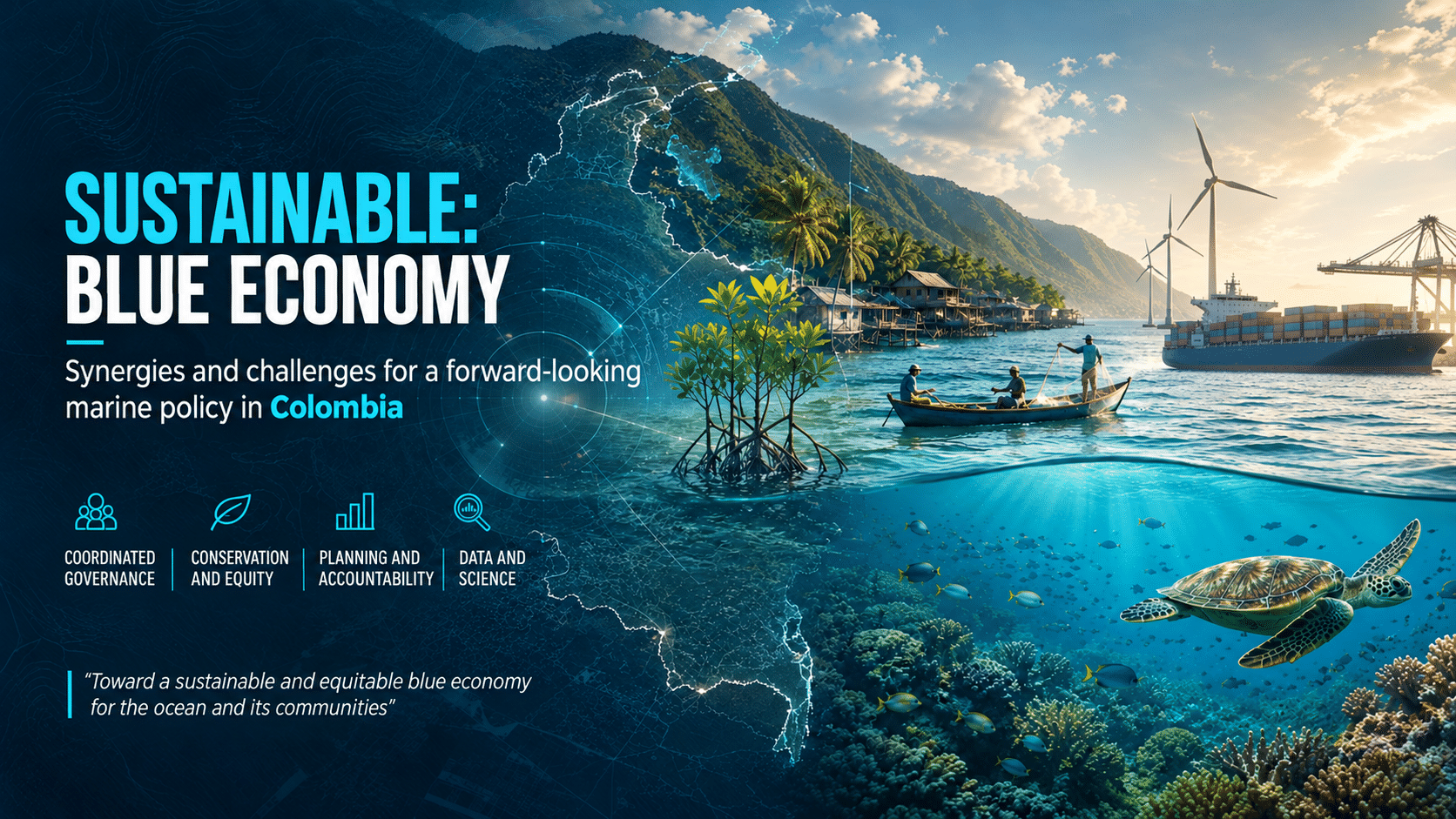
AI-generated cover image
The recent Regional Report on Sustainable Blue Economy in Latin America and the Caribbean by CAF fulfills a necessary task: organizing various concepts and ideas into an agenda aimed at creating a regional transition narrative around the ocean. The ocean cannot and must not be understood solely as a physical medium for economic activities, but rather as an ecological, climate, social, and productive matrix that demands planning, investment, innovation, and governance. The document is of special importance because it presents this as a cross-cutting framework articulating prosperity, conservation, and equity—an approach that aligns perfectly with the work we at CEMarin have been advancing regarding inputs for updating the national environmental policy for seas, oceans, and insular spaces. It is precisely within this research space that we ask how transferable these regional recommendations are to the Colombian context, which we conclude maintains flaws ranging from a marine-coastal institutional framework marked by jurisdictional fragmentation, low binding force of its instruments, and deep territorial asymmetries (CAF, 2026; CEMarin, 2025).
This is where we proceed to perform a synergistic analysis between the CAF report, which offers an architecture of opportunity, and the CEMarin report on public policy, which shows the real conditions of possibility, understanding two visions that are similar yet divergent at the same time. While the CAF report operates from a regional scale—identifying trends, gaps, and levers manifested in sustainable ocean plans, blue financing, innovation, regional cooperation, port decarbonization, regenerative tourism, blue carbon, and data strengthening—the report on marine environmental policy carried out by CEMarin lands the discussion in Colombia’s public policy ecosystem and institutional architecture around the ocean (PNAOCI, SINA, CCO, MinAmbiente, coastal CARs, POMIUAC, marine spatial planning, environmental determinants, Escazú, pollution, erosion, and socioeconomic diagnosis).
The first point of synergy lies in governance mechanisms. CAF insists that a Sustainable Blue Economy requires intersectoral coordination and coherent regulatory frameworks. At CEMarin, we agree, but we also add an element that the regional approach does not always develop with sufficient legal rigor: namely, that without binding capacity, governance is merely discursive coordination. For its part, the technical diagnosis on a possible update of the PNAOCI takes a more critical stance. In fact, the current PNAOCI was pioneering in its time, but its design responds to a context prior to the contemporary expansion of concepts such as blue economy, marine spatial planning, adaptive management, 30×30, oceanic environmental justice, and ocean-climate financing. Furthermore, the role of the Colombian Ocean Commission (CCO) remains predominantly advisory, the environmental regulatory leadership under the Ministry of Environment is not sufficiently strengthened, and planning tools and instruments such as POMIUACs have had limited implementation due to resources, regulatory gaps, and procedural burdens.
For Colombia, which possesses a robust although inefficient institutional and policy architecture in marine environmental matters, adopting certain inputs from Sustainable Blue Economy proposals is attractive—many of which are already incorporated into the PNAOCI update exercise. This reinforces the idea that these concepts must be integrated by building on what has already been done and improving upon existing precedents, such as coastal-marine environmental determinants, enforceable marine spatial planning, and evidence traceability systems, which must include ex-ante territorial compatibility control mechanisms. On the other hand, without the efficient and effective development of these processes, there is a risk of merely serving as a legitimizing label for new pressures on already degraded areas, increased uncontrolled tourism on highly vulnerable ecosystems, the advance of offshore energy projects lacking social mapping that accounts for regional realities, or the creation of blue carbon capture regulatory mechanisms without clear rules on ownership, permanence, and benefits. This clearly demonstrates that not everything blue is necessarily sustainable, and not everything sustainable is per se just.
The contribution of the updating process consists precisely in conditioning the Colombian translation of the CAF agenda. It does so by proposing a conceptual foundation that goes beyond general principles, seeking instead to turn them into public decision-making criteria: ecological integrity, comprehensive pollution prevention and control, precaution as a cross-cutting clause facing scientific uncertainty, environmental democracy, prevalence of coastal-marine environmental determinants, scientific basis, monitoring and open data, integrated ICZM-MSP planning, marine biosecurity, fisheries with an ecosystem approach and traceability, a sustainable and just blue economy, and bioceanic cooperation—to name just a few relevant aspects. This highlights that such an architecture is not merely rhetorical, but aims to progressively codify marine public policy into law (CEMarin, 2025).
The second synergy is found in the transition from planning toward enforceability mechanisms. CAF assigns a central place to Sustainable Ocean Plans, understood as instruments to order uses, reduce conflicts, prioritize investments, and connect conservation with development. In Colombia, the diagnostic outcome serving as the baseline for the policy update compels a more prudent reading: before multiplying plans and programs, analysis yields the certainty that it is necessary to establish a clear normative hierarchy among them to ensure greater legal interoperability. Thus, these recommendations should not and cannot be implemented as a new instrument without reviewing their relationship with existing tools such as POMIUAC, coastal land-use plans (POT), environmental licensing, maritime concessions, protected areas, OECMs, risk management plans, port instruments, and the jurisdictions of DIMAR, MinAmbiente, ANLA, AUNAP, CARs, and territorial entities.
This is perhaps the main implication for the Colombian model. CAF’s recommendations must be adapted under a logic of institutional sequencing. First, consolidate information and decision rules. Second, establish binding spatial compatibilities. Third, design blue investment portfolios. Fourth, unlock financial instruments, but under socio-ecological safeguards. That is to say, blue financing cannot precede governance; it must follow it, or at least be constructed simultaneously with it.
The environmental diagnosis reinforces this caution. Through the report conducted by CEMarin, a marine-coastal reality subjected to factors such as erosion, pollution, resource overexploitation, sea-level rise, and differential pressures on corals, mangroves, seagrasses, beaches, deep seabeds, and island areas is documented. Data on marine and coastal water quality show heterogeneous conditions, with monitoring stations ranging from optimal to abysmal. In the Pacific, concerns persist regarding hydrocarbons, mercury, sewage, and research constraints stemming from technical, spatial, and social factors. This means that Colombia’s blue economy does not start from a neutral baseline, but rather from an abundant variety of accumulated environmental liabilities manifested through two vectors: on one hand, persistent historical regional inequalities, and on the other, a considerable number of identified ecosystems that are already responding to stress (CEMarin, 2025).
Therefore, adapting the CAF report requires geographically differentiating our coastal, marine, and oceanic environments. The Colombian Caribbean concentrates ports, tourism, real estate pressure, coastal erosion, energy projects, and high conflict over coastal land use. The Pacific possesses immense ecological and cultural density, but suffers from deficits in infrastructure, connectivity, monitoring, security, and institutional capacity. The insular Caribbean faces narrow biophysical limits and a sensitive relationship among tourism, water, waste, reefs, Raizal identity, and climate change. Attempting a single blue economy policy for these territories would be technically poor and legally clumsy; thus, an updated PNAOCI should function as a common framework featuring differentiated regional modules and ecological and social prioritization criteria.
The third synergy lies in science and data. CAF notes that the region needs innovation, monitoring, and information systems to sustain decision-making. The inputs report prepared by CEMarin adds a more demanding formulation: evidence traceability must become a validity condition for marine-coastal acts and decisions. This would shift “best available information” from a standard policy catchphrase to a verifiable procedural standard characterized by identified sources, explicit methodologies, metadata, interoperability, active transparency, and periodic evaluation. In a country with conflicts over concessions, beach occupancy, infrastructure, discharges, and protected areas, such a standard reduces discretion and litigation while improving institutional trust.
In terms of blue financing, coordination must be equally critical. CAF promotes blue bonds, debt swaps, trust funds, blue carbon, blended finance, and ocean-climate instruments. These are useful tools, but they are not entirely harmless. They can mobilize resources or generate new forms of ecological value appropriation without distributive justice. Under this premise, CEMarin’s proposed policy update provides a conceptual safeguard encompassing a sustainable and just blue economy tied to socio-ecological transitions. For Colombia, this means that blue carbon projects, mangrove restoration, nature tourism, or fisheries innovation must incorporate effective participation, local benefit sharing, independent monitoring, ethnic rights, a gender perspective, and transparency mechanisms—ensuring that the community is not merely a static backdrop for the project, but rather an active decision-maker and real beneficiary (CAF, 2026; CEMarin, 2025).
The analysis of both documents also reveals a common deficit: the tension between ambition and state capacity. CAF envisions a “solution region”; CEMarin shows a State that still needs to fine-tune its mechanisms. This tension does not invalidate the blue agenda; it makes it more honest. Colombia can indeed adapt the regional recommendations, but not through mimetic adoption. An institutional translation is required—one that entails elevating the marine-coastal dimension within NDCs, strengthening maritime-port decarbonization, establishing a national stance on blue carbon and Article 6 of the Paris Agreement, activating MSP/ICZM, updating the PNAOCI with enforceable principles, strengthening environmental regulatory oversight, integrating databases, and building subnational governance. Without these measures, opportunities turn into vulnerabilities.
In this context, our role at CEMarin provides a technical mediation between the international agenda and Colombian reality that goes beyond repeating global standards, reorganizing them around national challenges instead. Nor does it stop at diagnosis; it proposes realistic roadmaps to achieve the set objectives. Its greatest contribution is demonstrating that a Sustainable Blue Economy will only be viable in Colombia if it ceases to be a sector-specific promise and becomes a public decision-making system grounded in evidence, precaution, normative hierarchy, participation, and territorial justice.


No Comments