

06 Jun Marine Litter in Different Beaches of the Gulf of Tribugá, Colombian Pacific

Co-authors: Vélez-Moreno I.1, Álvarez-Vargas J.1, Fonseca-López F.1, Quan-Young LI.1
1. Universidad CES, Colombia.
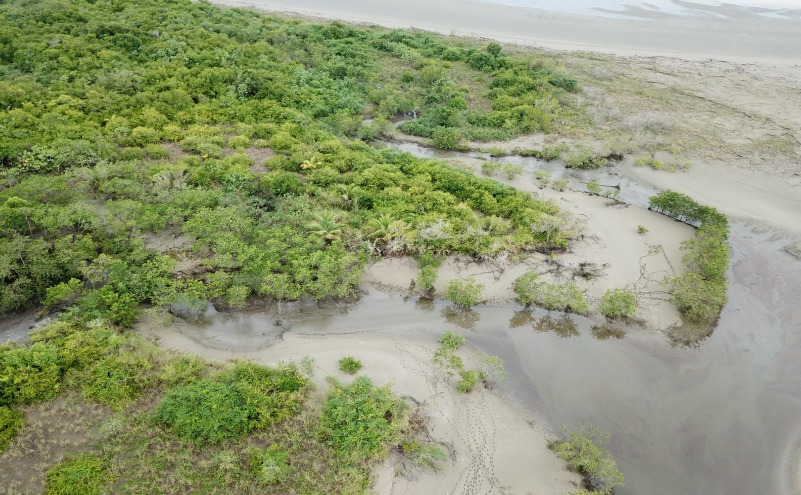
Cover photo: Aerial view of the beaches in the Gulf of Tribugá | by: Juan Carlos Mejía
Waste production, in particular plastics, has increased almost 230-fold, reaching 460 million tons in 20191. These wastes accumulate in various ecosystems, primarily in marine-coastal environments. Chemical and physical factors cause plastic to fragment into microplastics (MPs)2, which can enter tissues through direct or indirect ingestion, causing severe impacts such as intestinal blockages, physiological, sexual, or behavioral changes, and even death3. In Colombia, marine litter studies have mostly focused on plastics and marine ecosystems in the Caribbean, while little is known about the Pacific coast4-6. Therefore, the aim of this study was to document the presence of marine litter in the Gulf of Tribugá, as well as its association with marine-coastal organisms on different beaches.
Methodology
Two samplings were developed to evaluate the presence of plastic particles (PPP). In November 2022, samples were collected at six stations along the Coquí, Joví, and Jurubirá rivers, as well as on their beaches. A total of 50 mL of surface water, sediment samples using a PVC corer, and fish provided by local fishers were gathered. The digestive tracts of the fish were extracted for further analysis. The samples were treated with a KCl solution, processed using a vacuum pump, and dried at 70°C. The isolated PPPs were analyzed for elasticity, buoyancy, rehydration, hardness, size, shape, and color. Both the sampling and microplastic processing followed standardized protocols4,7-10.
In May 2024, an active search for marine litter was carried out on the beaches of Guachalito, Jurubirá, and Joví. The collected macro-litter was stored in 70% alcohol and transported to the CES University laboratory, where the associated organisms were identified up to major taxonomic groups using stereomicroscopy.
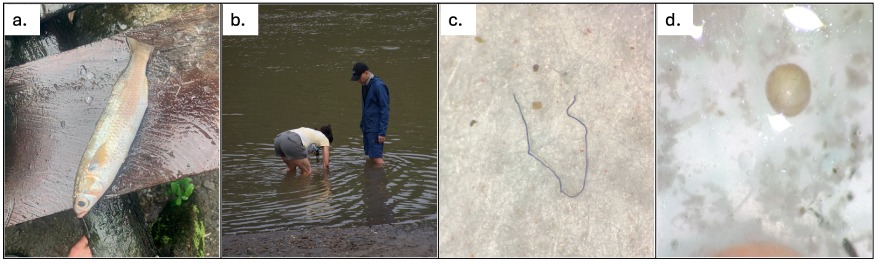
Figure 1. Sampling 2023. A. Collected fish, B. Sediment sampling using a homemade PVC corer, C. Blue filament, the most prevalent particle across all matrices, D. Transparent fragment found in the digestive tract of Centropomus armatus.
A total of 17 samples of PPPs were collected from water, sediment, and fish, both in riverine and coastal areas of Coquí, Jurubirá, and Joví, including the digestive tracts of four fish species. Across all sample types, blue and filamentous particles were the most prevalent. The highest concentration of PPPs in surface waters was recorded off the coast of Jurubirá, with 0.046 particles/mL, while in sediments, Coquí showed the highest density with 0.074 particles/g. The fishes studied were: Pagrus sp. (Pargo), Caranx caninus (Jurelillo), Centropomus armatus (Gualajo), Mugil cephalus (Liza). The individuals with the highest number of PPPs were C. armatus (11 particles/ind), C. caninus (10 particles/ind), and M. cephalus (4 particles/ind). These are all species commonly found in both coastal and mangrove habitats of the Colombian Pacific and are widely consumed in the region (Castellanos-Galindo et al., 2015) (Figure 1).
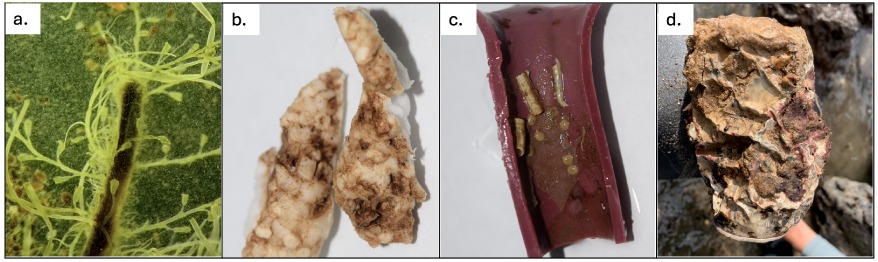
Figure 2. Organisms associated with plastic litter. A. Hydrozoa, Ulva flexuosa, Lyngbya associated with a sack fiber, B. Cianobacterias, Rhodophyta y Bacillariophyceae en icopor, C. Plastic bottle serving as substrate for Polychaeta, Corallinales, Bryozoa and Balanus and D. Polysiphonia, Gelidiella, Cladophora, Heterosiphonia, Syllidae, Bivalvia, Ceramiales, Rhodophyta and Chlorophyta on a metal can.
Regarding marine litter collected in 2024, sacks, cans, polystyrene, and plastic bottles were identified. All plastic litter types predominate algae, including Rhodophyta, Heterokontophyta, Chlorophyta, and Cyanobacteria. Cans, plastic bottles, and fibers sacks were the substrates hosting the highest number of taxonomic groups, such as algae and invertebrates (Figure 2). Notably, polychaete tubes adhered to plastic bottles were found to contain PPPs within their structure, highlighting the different ways in which marine biota are incorporating plastic waste into their habitats.
Discussions and conclusions
The particles found in the different matrices, while meeting the optical criteria to be considered microplastics, cannot be definitively confirmed without the use of analytical techniques such as FTIR to verify polymer identification12,13. Therefore, all are classified as potential plastic particles. However, in the case of marine litter, certain polymers can indeed be identified, like a high-density polyethylene (HDPE), commonly used in detergent bottles (Figure 2c); polypropylene, used in the construction of sacks (Figure 2a); polystyrene; and aluminum cans. These anthropogenic materials are clearly being used as substrates by marine biota.
This study concludes that in the beaches of Chocó, PPPs of various sizes, shapes, and colors are present in water, sediments, and fish. This increases the risk of these particles severely impacting the health of organisms and ecosystems by being transferred through trophic networks. PPPs are likely to be consumed by fish either directly, through their diet, or due to their presence in a contaminated environment (water and sediment). Likewise, considering the degradation potential of marine litter—particularly plastics—macrolitter represents a significant risk. This study demonstrated that macrolitter is being used as a substrate by a wide variety of invertebrates and even algae, which represent the first link in the food web. This interaction may compromise their vital functions, as shown in previous studies14, while also forming algal aggregates that could attract other organisms. Therefore, it is essential to promote proper waste disposal in nearby or upstream populated areas that influence marine-coastal ecosystems. Doing so will help limit interactions between biota and debris at multiple levels, preventing serious impacts on these vulnerable ecosystems.


No Comments