

25 May Humpback Whale Conservation in Colombia is in Our Hands: Nature-Based Solutions (NbS)

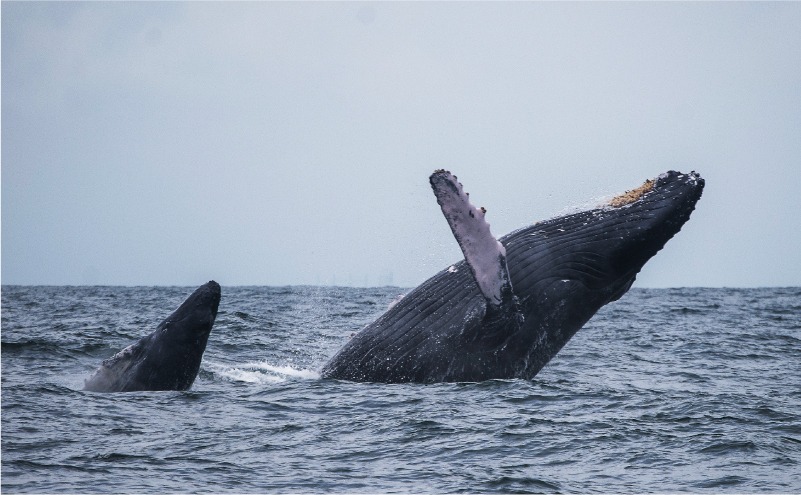
Cover photo: Humpback whale (Megaptera novaeangliae) mother and calf in Colombian Pacific waters. | by: Isabel C. Avila.
The humpback whale (Megaptera novaeangliae) is a cosmopolitan and migratory marine mammal that inhabits Colombian Pacific waters between May and December, where it breeds, gives birth, and nurses its calves (Figure 1; Avila et al., 2020). In these breeding grounds, the whales engage in vital life cycle activities, including mating, calving, lactation, nursing, resting, and socializing, while exhibiting a wide range of aerial behaviors such as breaching, tail slapping, and flipper slapping (Avila, 2000, 2006). Among these behaviors is their complex, repetitive, and long-duration song (Pineda, 2022; Avila et al., 2023), associated with courtship and reproduction (Payne & McVay, 1971).
Colombian humpback whales belong to the “Stock G” population, which feeds during summer in southern Chile and the Antarctic Peninsula and breeds in winter in the tropical waters of Ecuador, Colombia, Panama, and Costa Rica (Stevick et al., 2004; Acevedo et al., 2017; Marcondes et al., 2021). The current estimated population of Stock G is approximately 12,000 individuals (Félix et al., 2021). Despite their recovery from near extinction in the 1960s due to commercial whaling, humpback whales now face the largest at-risk habitat range globally due to ongoing threats (Avila et al., 2018).
In Colombia, they are among the most affected species in terms of threat diversity (Avila & Giraldo, 2022). Major threats include vessel collisions, disturbance from whale-watching boats, pollution, accidental entanglement in fishing gear (Capella et al., 2001; Avila et al., 2013, 2015, 2017, 2018, 2021, 2022; Rey-Baquero et al., 2021), and climate change—particularly shifts in Antarctic sea ice coverage affecting prey availability (Avila et al., 2020).
Whales play a critical role in marine ecosystems and human well-being by nutrient cycling and ocean fertilization, enhancing marine productivity and climate change mitigation (Chami et al., 2019; Doughty et al., 2016; Tavares et al., 2019). Additionally, humpback whales are a flagship species for marine tourism, particularly whale watching (Figure 2; Arias-Gaviria et al., 2011; Avila et al., 2021).This kind of tourism generates economic benefits for local communities and promotes ocean conservation. In Valle del Cauca, whale-watching tourism has grown by over 140% in the last decade, generating significant economic benefits (at least $362,409 USD monthly; Avila et al., 2021). Urgent action is needed to safeguard whales and their habitat.
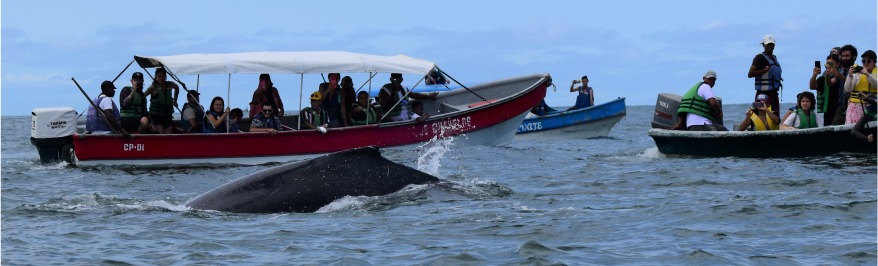
Figure 2. Whale-watching tourism activity in Uramba Bahía Málaga National Natural Park, Colombia. Photo: Isabel C. Avila..
Nature-based Solutions (NbS)—approaches that harness ecosystems to address socio-environmental challenges—offer a sustainable pathway forward. Key measures include:
1) Responsible Consumption: Support local products, reduce single-use plastics, and promote beach cleanups and proper waste management to prevent marine pollution.
2) Sustainable Fishing Practices: Adopt whale-friendly fishing methods to minimize bycatch and establish a national entanglement response protocol aligned with the Global Whale Entanglement Response Network (GWERN) and Bycatch Mitigation Initiative (BMI) (Avila et al., 2022).
3) Responsible Whale Watching: Strictly adhere to whale-watching guidelines (MINAMBIENTE, 2017) and promote sustainable tourism with stakeholder engagement (Avila et al., 2021).
4) Maritime Traffic Mitigation: Enforce speed limits (<10 knots) in whale habitats and promote propeller guards (Avila et al., 2017, 2021).
5) Collaborative Long-Term Monitoring: Foster community-based monitoring programs involving fishers, tourists, and locals to track whales and habitat health.
6) Protection of critical whale habitats. The humpback whale inhabits the coastal waters of the Colombian Pacific, primarily in areas such as Gorgona Island (Cauca), Bahía Málaga (Valle del Cauca), Tumaco (Nariño), and Bahía Solano and Bahía de Cupica (Chocó) (Flórez-González et al., 2007; Arias et al., 2011; Palacios et al., 2012). These zones are vital for their survival, making the conservation of these habitats essential.
This last objective can be achieved through the creation of Marine Protected Areas (MPAs) and by strengthening protection and monitoring actions in already established areas, such as Gorgona National Natural Park (PNN), Uramba Bahía Málaga National Natural Park, and Utría National Natural Park. Additionally, the IUCN Marine Mammal Protected Areas Task Force has designated 36 Important Marine Mammal Areas (IMMAs) in the Tropical and Temperate Southeast Pacific Ocean, including one IMMA in Colombian waters: the Gorgona-Tribugá-Malpelo IMMA (IUCN-MMPATF, 2023). However, despite the significance of these areas, some of them are currently threatened. A clear example is Gorgona National Natural Park, where the construction of a military base within its territory is planned (González-Posso & Toro-Pérez, 2024), and Utría National Natural Park, where the construction of a commercial port in its vicinity has been proposed (Mosquera, 2023). The development of these projects not only endangers whales and biodiversity but also local communities. Furthermore, it compromises global marine biodiversity conservation and environmental sustainability efforts. For this reason, urgent measures must be taken to prevent the implementation of these projects.
Nature-Based Solutions are fundamental for protecting humpback whales in Colombia, as they focus not only on direct species conservation but also on habitat protection and strengthening the relationship between local communities and their natural environment. Implementing these solutions is in our hands.


No Comments