

06 Jun sea4soCiety – Searching for Solutions for Carbon Sequestration in Coastal Ecosystems

Co-authors: Camilo Arietta1, Mondane Fouqueray1, José Ernesto Mancera Pineda3, Mirco Wölfelschneider1, Martin Zimmer1,2.
1. Leibniz Centre for Tropical Marine Research (ZMT), Bremen, Germany
2. University of Bremen, Faculty 2 Biology/Chemistry, Bremen, Germany
3. Department of Biology, Faculty of Sciences, Bogotá Campus, Universidad Nacional de Colombia, Bogotá, Colombia.
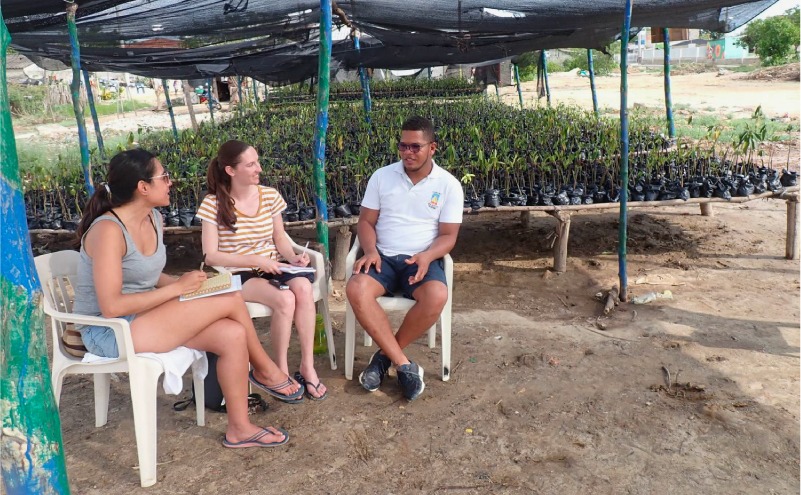
Cover photo: Interview conducted by Mondane Fouqueray (with the support of Carolina Hortúa Romero for translation) with the head of the Tuarisba cooperative, Juan Cuadro, at a mangrove nursery in Ararca, Colombia. | by: Soyla Kraus
Among the major challenges humankind currently faces, climate change is one of the most pressing, with increasingly tangible effects, particularly for coastal communities, both human and non-human. To address this pressing issue, strategies towards emission reductions or avoidance and carbon dioxide removal (CDR) from the atmosphere (also referred to as negative emissions) have to be evaluated open-mindedly and implemented as climate change mitigation actions, in order to reach the goals set in the Paris Agreement.
In this context, sea4soCiety1 investigates the potential of blue carbon ecosystems (BCE), namely mangrove forests, seagrass beds and saltmarshes, as Nature-based Solution (NbS) for CDR in study sites located in Colombia, Malaysia and Germany, using a multi-, inter-, and transdisciplinary approach. By integrating various natural and social sciences, sea4soCiety considers all relevant legal, political, ethical, environmental (feasibility), and societal (desirability) aspects essential for the future implementation of BCE-based NbS for CDR.
To fully assess the potential of BCE for CDR, several steps are necessary. These steps are summarized below, along with their alignment with the NbS criteria (set in the IUCN Global Standard for NbS; IUCN, 2020) they align with:
1) Mapping the current and suitable area for BCE (re-)establishment.
2) Understanding carbon sequestration and storage processes and rates.
3) Understanding fluxes of organic matter (OM) and greenhouse gases (GHG).
4) Upscaling carbon budgets to regional and, if possible, global scales using Earth system modeling and digital twin (c.f. Van Dam et al. 2024) approaches.
5) Assessing the risks and co-benefits of BCE (re-)establishment (sensu Zimmer et al., 2022). This step aligns with criterion 4, which ensures that NbS are economically viable, sustainable, and justified compared to alternative solutions. It also partly aligns with criterion 2 by emphasizing the need to consider the complexity and dynamics of socio-ecological systems, integrating risk identification and management within and beyond the intervention area. Furthermore, it relates to criterion 6 by acknowledging the potential trade-offs of NbS interventions. Alternative approaches and trade-offs are implicitly addressed by the CDRmare project ASMASYS2.
6) Evaluating the technical feasibility of implementation concerning frameworks and societal desirability3. This crucial step addresses criterion 1: “NbS effectively address societal challenges”, identified as a priority by those directly affected by the challenge, through a transparent and inclusive (particularly of right holders) decision-making processes; criterion 5: “NbS are based on inclusive, transparent and empowering governance processes”, based on mutual respect and equality among all stakeholders, warranting the rights of indigenous peoples and local communities (IPLCs) to Free, Prior and Informed Consent (FPIC); and criterion 6: “NbS equitably balance trade-offs between achievement of their primary goal(s) and the continued provision of multiple benefits” focusing notably on the respect of the rights, usage of, and access to, land and resources of different stakeholders, and acknowledging the trade-offs in land- or resource-management based on the different needs and interests of the affected stakeholders.
7) Establishing a reliable Monitoring, Reporting and Verification approach for BCE-based CDR (see Van Dam et al., 2024; Zimmer et al., submitted) to be communicated to policy-makers. This step aligns with criterion 7: “NbS are managed adaptively, based on evidence”, that encompasses regular monitoring and evaluation of the intervention to allow for adaptive management based on evidence; and criterion 8: “NbS are sustainable and mainstreamed within an appropriate jurisdictional context”, that calls for better inclusion of NbS in policy frameworks.
Lessons learned from a social sciences perspective:
Focusing here on the knowledge gained during the activities conducted in Colombia, in the region of the peninsula of Barú, through interviews (Figure 1 – Cover) and stakeholder workshops, sea4soCiety gained important insights on the potential of BCE for CDR actions in the region. People from local communities perceive “climate change” and its effects (for example, the fish are moving from shallow bays into deeper water) and “sea-level rise” (notably through experiencing the effect of heavy erosion). While most community members are unfamiliar with the concept of “blue carbon” or how BCE can contribute to climate change mitigation, some expressed interest in community-based funding mechanisms related to carbon credits. Regardless of their perception of coastal vegetated ecosystem as a carbon sequestration solution, community members tended to be very supportive of mangrove expansion and were aware of their potential of counteracting climate change effects and supporting their livelihoods. They value BCE and their ecosystem services, primarily in the context of coastal protection and (small-scale) fisheries, i.e. what we would refer to as co-benefits within sea4society. There are efforts to (re-)establish mangrove stands, but not as a CDR measure. Funding is provided to local community groups for only short periods, to grow and plant specific numbers of mangrove seedlings as compensation for mangrove loss due to activities from the private sector. A lack of reliable and long-term funding counteracts aims for the sustainability of the actions which also requires a proper consultative and inclusive process of planning, implementation, governance and monitoring with all affected stakeholder groups, to ensure long-term support from local actors and stakeholders. The privatization of coastal land was also mentioned as a potential barrier to further mangrove (re-)establishment. The recognition of BCE (re-)establishment as efficient NbS for climate change mitigation will require better communication of the Blue Carbon concept and the potential of coastal ecosystems as BCE.
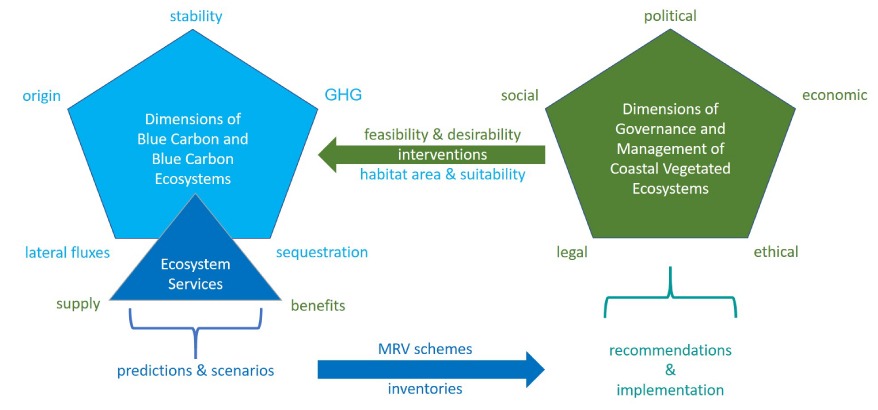
Figure 2: sea4soCiety takes into account various aspects and dimensions of social and natural sciences for defining interventions, their evaluation and implementation, and identifying corresponding recommendations.
Next steps and challenges ahead:
The second phase of sea4soCiety (Figure 2) has now been launched. Building on the lessons learned in the first phase, this phase will address remaining knowledge gaps by: a) implementing the first region-specific recommendations regarding the most efficient and societally accepted contribution of BCE to CDR and long-term storage of organic carbon upon areal ecosystem extension; b) providing a proof of concept of BCE extension as a measure of marine CDR through enhanced sequestration and storage of “blue carbon”; c) accurately budgeting sequestration and storage rates by, as well as GHG emissions and lateral losses of OM from, BCE; and d) refining MRV schemes for BCE-based CDR, carbon storage and its additionality, including co-benefits, risks, and societal implications.
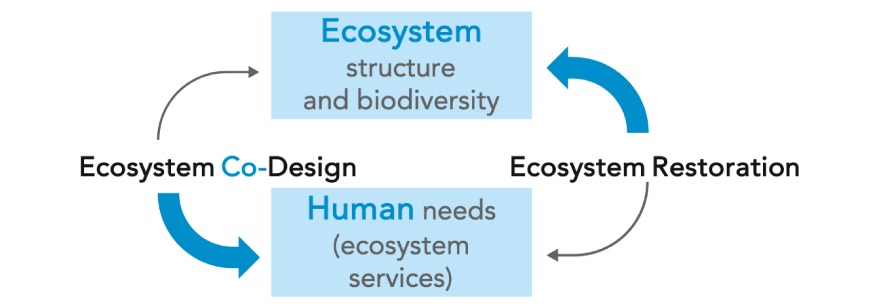
Figure 3: Illustration of the Ecosystem Co-Design approach, focusing on human needs, especially those of local actors. Those human needs would represent the societal challenges to be addressed in the framework of Nature-based Solutions (NbS). Modified after Zimmer 2018. Courtesy of J. Geburzi & M. Zimmer
Ultimately, sea4soCiety seeks to apply the Ecosystem Co-Design concept (Zimmer 2018; Figure 3), a recent approach to ecosystem management, focusing on human needs for particular ecosystem services rather than on ecosystem structure or biodiversity, in order to identify interventions and activities to be implemented. For example, if the major challenges to address were coastal erosion due to sea-level rise, the Ecosystem Co-Design approach would favor the establishment of a (potentially monospecific) stand of the mangrove species that most efficiently provides coastal protection, provided that this is the best solution to counteract erosion – the establishment of a mixed mangrove stand would tend to (re-)establish the forest structure and associated biodiversity but might be less efficient in preventing coastal erosion. With this in mind, Ecosystem Co-Design can align with most of the NbS Criteria, but will, in some instances, not align with criterion 3) “NbS result in a net gain to biodiversity and ecosystem integrity”. This is, from our point of view, part of the trade-off evaluation that needs to be conducted according to criterion 6, where all stakeholders should have the opportunity to share their views and values in an equitable way.
While proper inclusion of local actors is an integral part of the IUCN Global Standard for NbS, their needs, interests, values and knowledge are often neglected in the planning, implementation, governing and monitoring of NbS, and even NbS actions can come with high costs for the local actors, including restriction of access to areas that are essential for their subsistence. The latter could result in vetoing further Blue Carbon projects. Applying the Ecosystem Co-Design approach can prevent management decisions that conflict with social justice principles, promote people-inclusive conservation and management strategies, and facilitate the integration of local ecological knowledge (LEK; Grimm et al., 2024) into future NbS initiatives. Nonetheless, Ecosystem Co-Design is a challenge: it requires identifying key stakeholders, understanding of societal organization and local governance, breaking top-down practices, communication and trust-building among all involved actors, and addressing management trade-offs and their respective motivations. All of the above measures are time-consuming, and sufficient resources should be allocated for an initial co-design phase of NbS projects. Nature-based Solutions for carbon sequestration in coastal ecosystems will only be an appropriate approach, if they properly include the needs, values, knowledge and rights of all affected actors, particularly indigenous peoples and local communities.


No Comments